

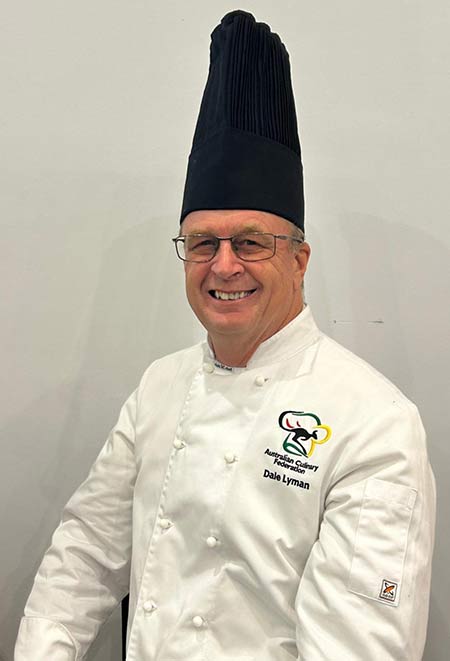
The Sidney Taylor Memorial Black Hat is a distinguished honour steeped in culinary heritage. To understand its significance today, one must look back at its origins and the evolution of professional standards in the kitchen.
Historical Foundations
The tradition of the Black Hat originates from the English Master Cooks, where the black skullcap was a garment reserved exclusively for practitioners of the highest trade standing. This visual symbol served as a badge of authority, wisdom, and mastery within the guild system.
In 1980, this tradition was formally adopted in Australia to provide the domestic industry with a similar mark of distinction. By 1990, the award was formally established in its current iteration by Aelfryn Bailey, becoming a cornerstone of the Australian Culinary Federation’s recognition program.
Shifting the Focus: From Skill to Service
While most culinary accolades focus on technical prowess or restaurant ratings, the Black Hat was designed to measure a chef’s character and longevity. It moved the spotlight away from the “plate” and toward the “profession,” valuing:
- Ethical Standards: A commitment to the integrity and advancement of the trade.
- Sustained Contribution: A mandatory minimum of ten years of meaningful service to the industry.
- Professionalism: Demonstrating leadership, conscientiousness, and a "good-natured" approach to mentorship.
The Modern Legacy
Today, the award is granted by the ACF Victoria and represents the absolute pinnacle of achievement in Australian commercial cookery. It is more than a trophy; it is a lifetime appointment.
The award highly values dedication to the industry alongside culinary expertise. Its primary aim is to honour the extent, impact, and duration of a chef’s contributions to commercial cookery.
Only chefs who have made exceptional contributions to the progress and development of Australian cuisine at the highest trade or professional levels are eligible for this respected award.
Those who meet the rigorous eligibility criteria are granted the right to wear the traditional Black Hat, receive Honorary Life Membership, and have their names recorded in perpetuity. This ensures that their contributions to the development of Australian cuisine are preserved as a historical record for future generations of chefs.
The award highly values dedication to the industry alongside culinary expertise. Its primary aim is to honour the extent, impact, and duration of a chef’s contributions to commercial cookery.
“What was it like to receive this, Honour?”
Disbelief and imposter syndrome are what come to mind first of all. I was greatly honoured to be asked if I would accept this award by Victorian Regional director Jacquline Bates. My initial thought was I was far too young to receive this award, then realised I just turned sixty years of age. I stark realisation I not as young as I think I am.
I certainly have never put myself in the same league as the amazing trail blazers and chefs who have been awarded this award. I feel deeply honoured that I was considered for and given this award.
In 1987 when I first joined what was then the Australasian guild of professional cooks (AGPC), I would never in my wildest dreams thought I would be on the same list as George Hill and Bernd Uber.
After completing my apprenticeship, travelling and establishing a career in restaurants, in 2006 I joined the Victorian committee of the Australian Culinary Federation ACF (formerly AGPC) and began teaching at William Angliss TAFE. At this point Geoge and Bernd became two of my most influential mentors.
I have been on the ACFV committee continuously since 2006. To be part of a group (tribe) for the last twenty years, wanting nothing more than to put back into our incredible and hard industry, has been intrinsically rewarding and I never expected recognition of this kind. The ACF has given me some amazing experiences and opportunities, such as:
- Committee member Young Chefs Development Team for World Chefs.
- Being Instrumental in establishing Young Chefs’ Clubs in every state and territory in Australia.
- Representing Australia at 2011 in the Bidvest World Cooks Tour Against Hunger, 2011, South Africa, 200 Chefs from 40 countries raised R5 million to feed children in South Africa, which equated to one meal a day for 500 hundred children for 5 years
- Presenting at World Association of Chefs Societies 34th World Chef Congress in Chile 2010.
- Pink Breakfast for Breast Cancer research.
- Judging nationally and internationally and convener of many competitions.
Being able to have the opportunity put back into an industry, mentor and hopefully make a small difference in young cooks’ lives is such a precious gift.
We make a living by what we get, but we make a life by what we give
— Winston Churchill
Dale Lyman
https://www.dalelyman.com
World Chefs Certified judge.
Australian Culinary Federation Victorian Life member.